Hip flexibility is among the most consistently discussed aspects of yoga practice for beginners, yet the available written record of how hip openness actually develops — across weeks of structured mat work — is notably sparse. This article attempts to correct that gap through documented observation of posture sequencing, holding duration, and the mechanical conditions under which hip mobility changes in practice.
What Anatomical Structures Are Being Addressed
The hip joint is a ball-and-socket structure surrounded by a dense arrangement of soft tissue: the hip flexors running through the front of the pelvis, the external rotators grouped at the back, the adductors along the inner thigh, and the iliotibial band spanning the outer leg. When practitioners refer to "tight hips", they are typically describing restricted range of motion in one or more of these muscle groups rather than any structural limitation of the joint itself.
In most beginners, the restriction is concentrated in the hip flexors — specifically the iliopsoas, which shortens with prolonged seated posture — and in the external rotators, which govern the rotation needed for postures like bound angle and half-pigeon. Understanding which group is most restricted informs the selection and sequencing of positions within a practice session.
Sequencing Observations: The First Eight Weeks
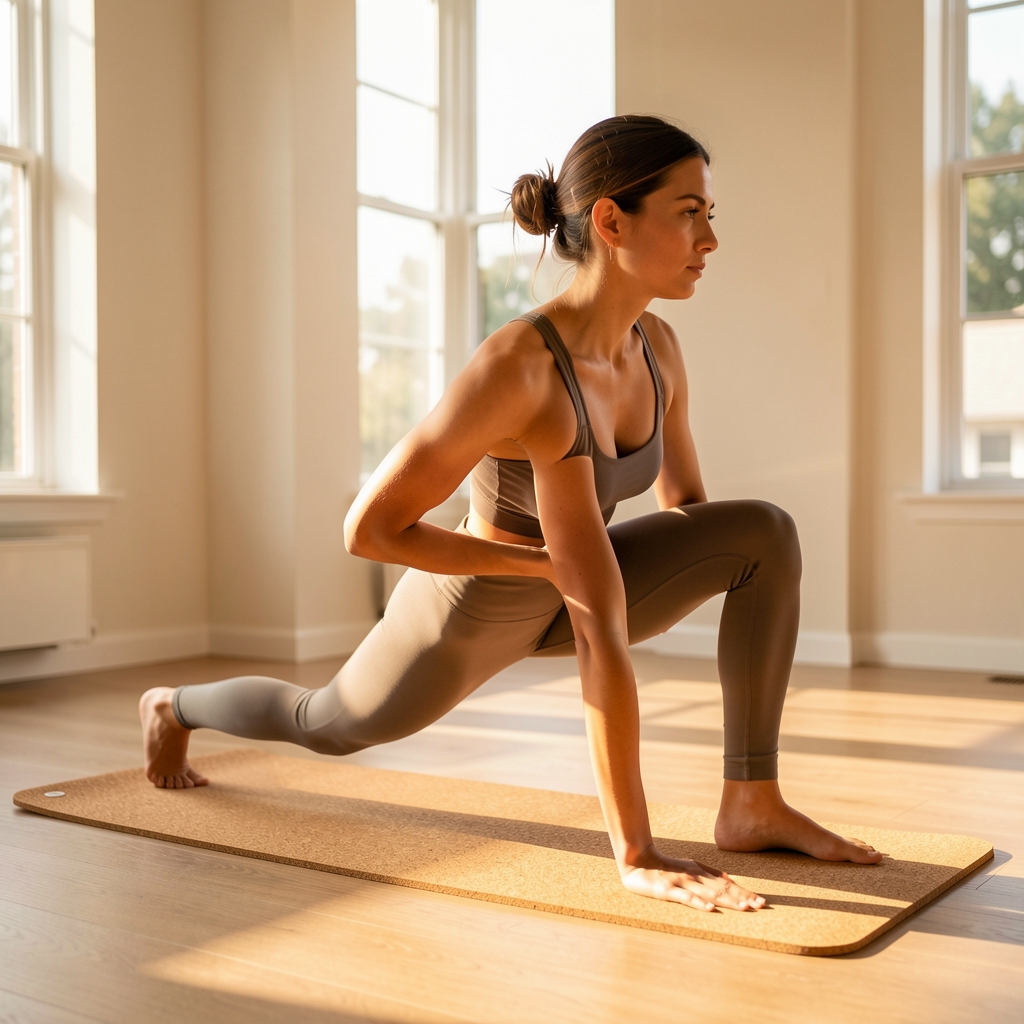
Across an eight-week structured routine of daily mat practice, four core positions formed the basis of the hip flexibility work: low lunge (anjaneyasana), reclined pigeon (supta kapotasana), wide-leg seated forward fold (upavistha konasana), and bound angle (baddha konasana). Sessions ran for 35 to 45 minutes. Each position was held for 90 seconds to three minutes, with breath- coordinated release at the end of each hold.
The observations recorded over this period followed a predictable pattern. Weeks one to three showed negligible change in the depth of postures but a marked reduction in the discomfort associated with holding. This is consistent with published biomechanics research on the distinction between neural-mediated flexibility response (the nervous system's tolerance of stretch sensation) and structural adaptation (actual lengthening of connective tissue). The first gains in a flexibility routine are predominantly neural, not structural.
From weeks four to six, measurable changes in posture depth became apparent. In bound angle, the knee-to-floor gap reduced from approximately 12 centimetres to 7 centimetres on the right side, and from 9 centimetres to 4 centimetres on the left. These measurements, taken with a simple ruler before and after each session, provide a coarse but consistent quantitative record. The asymmetry between sides — common and worth documenting — reflects the uneven loading patterns most people carry from daily habitual postures.
The first gains in a flexibility routine are predominantly neural, not structural. This distinction matters for setting reasonable expectations in the early weeks.
Tobias Ashcroft · Kalnore Review · February 2026The Role of Breath Coordination in Depth of Hold
One of the more consistently observed variables across the eight-week period was the relationship between exhale length and the achievable depth of a held position. Extended exhales — four to six seconds, as compared to passive natural exhales — consistently allowed an additional half-centimetre to one centimetre of movement into the posture at the bottom of the breath cycle.
This is not a surprising finding given the physiological relationship between the parasympathetic nervous system state associated with extended exhales and the reduction in protective muscular bracing. What is worth documenting is the reliability of this effect even in early practice, before any significant structural adaptation has occurred. Breath work functions as an immediate access mechanism, not merely a long-term development tool.
Prop Support and Its Effect on Session Consistency
The use of props — specifically folded blankets under the sitting bones in seated forward-fold variations, and a bolster under the back hip in reclined pigeon — proved to have a significant effect on session-to-session consistency during the early weeks. Sessions conducted without prop support showed a higher rate of early exit from positions, driven by the discomfort of unsupported pelvic tilt.
With blanket support under the sitting bones in wide-leg seated fold, average hold duration increased from 65 seconds (unsupported) to 105 seconds (supported) across the first three weeks of practice. This improvement in hold duration is directly relevant to adaptation: the connective tissue remodelling associated with flexibility gains requires sustained, low-load lengthening rather than brief high-effort engagement. Props that extend hold duration without discomfort are therefore not a modification for beginners to graduate out of — they are a precision instrument for improving the quality of the practice.
Asymmetry Documentation and Its Implications
Documenting left-right asymmetry is useful for two reasons: it provides a baseline against which progress can be measured, and it identifies which side requires more targeted sequencing. In practice, most beginners find that one side progresses more quickly than the other. This is not a problem to be solved through additional effort on the restricted side, but a pattern to be noted and accommodated.
A useful protocol is to begin the hip-opening sequence on the less mobile side, address the more open side second, and then return to the less mobile side for a final shorter hold. This creates an asymmetric session structure — intentionally — that accounts for real differences in tissue response rather than treating both sides identically.
Observations from Weeks Seven and Eight
By weeks seven and eight, the structural adaptation phase had become more pronounced. In reclined pigeon, the resting angle of the shin to the body's midline had shifted from approximately 45 degrees to 62 degrees on the right side. The quality of held positions had shifted noticeably: the initial period of discomfort at the start of a hold had shortened from approximately 40 seconds to 15 to 20 seconds before a plateau of relative ease was reached.
The record across this period suggests that eight weeks of daily practice, using the four documented positions with proper prop support and breath coordination, produces measurable and consistent gains in hip mobility. The progression is not linear — weeks four through six show the most rapid change — but it is, given an adequate documentation framework, predictable.
- Early flexibility gains are primarily neural; structural adaptation follows from week four onwards.
- Extended exhales (four to six seconds) reliably increase depth of hold by 0.5–1 cm per breath cycle.
- Prop support increases average hold duration by 40–60% in the first three weeks of practice.
- Left-right asymmetry is normal and should be documented rather than corrected by effort alone.
- Asymmetric sequencing — beginning and ending on the less mobile side — is a valid session structure.
- The most rapid measurable gains typically occur between weeks four and six of a daily routine.