Within yoga practice, breath coordination is often presented as a secondary concern — something attended to once the posture itself has been established. The documented evidence from sustained practice sessions suggests this ordering is worth reconsidering. Breath pattern appears to function not merely as accompaniment to posture but as a primary determinant of the quality and depth of alignment achievable in each position.
The Structural Relationship Between Breath and Spine
The diaphragm, the primary muscle of respiration, attaches directly to the lumbar vertebrae via the crura — the two tendinous structures descending from the diaphragm's central tendon to the bodies of L1 through L3. This anatomical arrangement means that diaphragmatic movement during breathing creates a direct mechanical interaction with the lumbar spine. On inhale, as the diaphragm descends and the thoracic cavity expands, there is a measurable tendency toward lumbar extension. On exhale, as the diaphragm ascends, the reverse mechanical effect reduces this extension.
In practice terms, this means that breath phase has a direct, documentable effect on lumbar curvature within any given posture. Positions requiring neutral or reduced lumbar curve — such as seated forward folds or reclined twists — are consistently more accessible during the exhale phase. Understanding and applying this relationship constitutes one of the more immediately useful observations available from biomechanics research for the beginner practitioner.
Documented Observations Across Three Core Postures
The observations below were collected across a twelve-week practice period, focusing on three postures where the breath-alignment relationship is most clearly observable: staff pose (dandasana), seated spinal twist (ardha matsyendrasana), and standing forward fold (uttanasana). In each case, measurements were taken of posture depth or angular change correlated with breath phase.
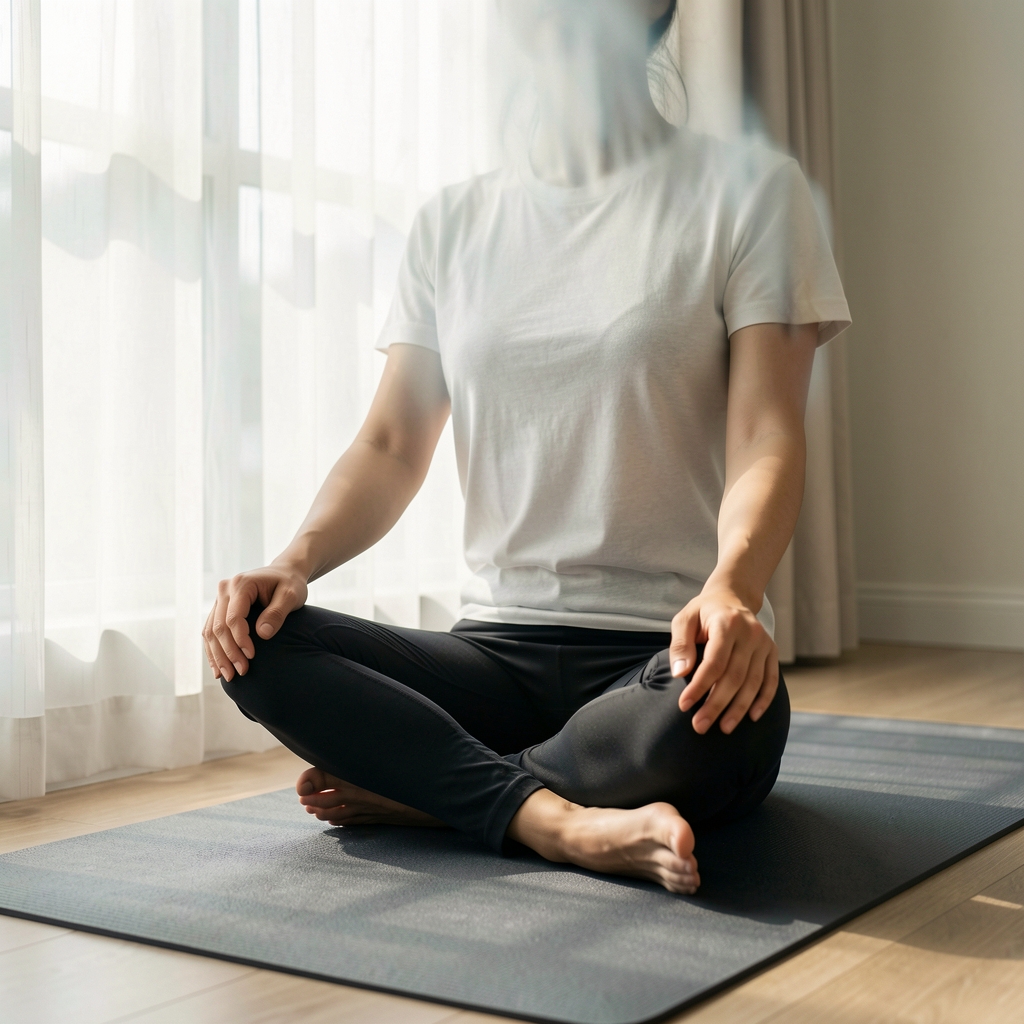
In dandasana, the capacity to maintain a fully upright spine — ideally perpendicular to the floor — was consistently greater on inhale than exhale. Spinal extension on inhale measured approximately 4 to 6 degrees greater than on exhale in the early weeks, reducing to 2 to 3 degrees by week ten as thoracic mobility improved. The inhale phase functions as a moment of spinal elongation that, if used deliberately, assists in establishing the correct neutral position from which forward folds and twists are then initiated.

In the seated spinal twist, the twist depth — measured as the angular difference between shoulder line and hip line — was consistently greater at the end of a full exhale compared to the same posture entered on inhale or mid-breath. Across the twelve-week record, exhale- initiated twist entries averaged 6 to 9 degrees more rotation than inhale entries in the same session. This finding held consistently from week three onwards.
In standing forward fold, the functional reach — fingertip distance to floor — was measurably closer on exhale in the early weeks. By week eight, the difference between breath phases had largely resolved, suggesting that structural lengthening of the posterior chain eventually reduces the moment-to-moment variability. This provides a useful marker of adaptation: as the breath-phase difference narrows, structural change is underway.
Breath phase has a direct, documentable effect on lumbar curvature within any given posture. This observation is immediately applicable, requiring no equipment and no prior experience.
Eleanor Whitfield · Senior Editor · Kalnore ReviewPractical Application: Coordinating Entry and Transition
The practical implication of these observations is straightforward to implement: initiate spinal elongation on inhale, and enter or deepen a position on exhale. This two-phase approach — inhale to extend, exhale to fold, rotate, or release — is consistent with the instructional tradition of most yoga lineages, but the value of understanding its biomechanical basis is that it transforms the instruction from a rule to be followed into a mechanism to be used deliberately.
A practitioner who understands that the exhale mechanically reduces lumbar extension can choose to lengthen the exhale in postures requiring posterior pelvic tilt, rather than applying effort through muscular activation alone. The distinction is significant: effort- based adjustment tends to produce bracing and reduced range; breath-coordinated adjustment tends to produce release and increased range.
Breath Rate and Its Effect on Postural Stability
Breath rate proved to be an independent variable with its own observable effects on alignment quality. Sessions conducted at a slower breath rate — five to six breaths per minute, as compared to the natural resting rate of 12 to 16 — showed consistently higher postural stability in balance postures, specifically tree pose (vrikshasana) and warrior three (virabhadrasana III).
The stability improvement at lower breath rates is consistent with the increased duration of the exhale phase relative to the breath cycle, and with the documented relationship between extended exhale and reduced sympathetic nervous system activation. Lower activation state correlates with reduced postural sway. In balance postures, where proprioceptive demand is high, the reduction in sway is practically significant.
The protocol that produced the most consistent stability results was a four-count inhale followed by a six-count exhale, with a brief natural pause at the bottom of the exhale. This rhythm was applied from the beginning of the session and maintained through balance work without adjustment. In weeks one to four, maintaining this rhythm required deliberate attention; from week five onwards it became a natural feature of practice.
Breath Work as Preparation for the Practice Session
A final observation worth documenting: the use of five to ten minutes of deliberate breath practice at the start of a session — specifically extended exhale breathing in a comfortable reclined or seated position — produced a measurable improvement in the quality of the first postures of the session. Sessions preceded by this breath preparation consistently showed greater initial depth in forward folds and shorter duration of early-hold discomfort in hip-opening postures.
The effect is almost certainly mediated by the shift in physiological activation state that extended exhale breathing produces — a reduction in resting muscular tone that applies across the whole body and persists for several minutes after the breath practice ends. For beginners who find the first few minutes of a session the most challenging, this preparatory protocol is among the more practical tools available.
- Inhale phase supports spinal elongation; exhale phase supports entry into folds, twists, and releases.
- Exhale-initiated twist entries averaged 6–9 degrees more rotation than inhale entries across weeks 3–12.
- The narrowing of breath-phase difference in forward fold is a reliable marker of structural adaptation.
- Slower breath rate (5–6 breaths/min) correlates with improved postural stability in balance postures.
- A four-count inhale and six-count exhale rhythm produced the most consistent stability results.
- Five to ten minutes of extended-exhale preparation before practice reduces early-session discomfort.